Arduino® UNO™ Q 4 GB Single Board Computer
19. August 2026 | Planegg
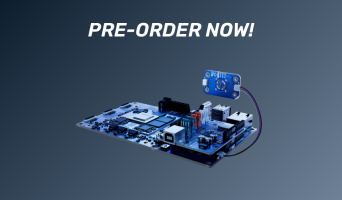
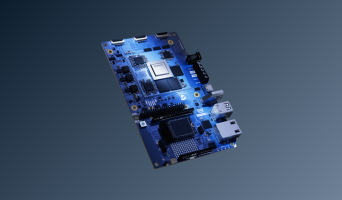
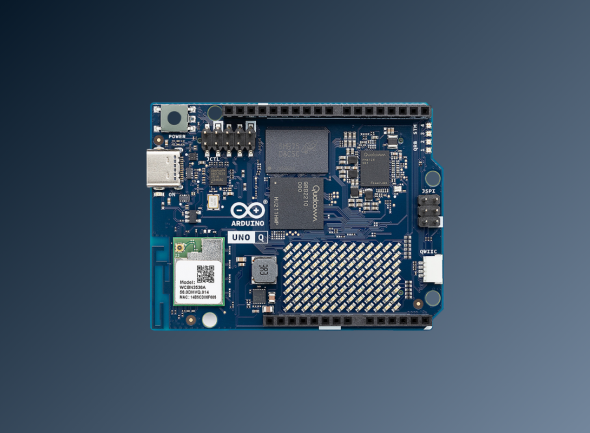
The Arduino® UNO Q 4GB single-board computer combines the Qualcomm® Dragonwing™ QRB2210 Microprocessor with the STMicroelectronics STM32U585 Microcontroller for high-performance Linux application processing and deterministic real-time control on a single development platform.
Qualcomm® Dragonwing™ QRB2210 combines a quad-core Arm® Cortex®-A53 CPU running at 2.0 GHz with an Adreno 702 GPU and two image signal processors. Running Debian Linux OS, the MPU supports embedded vision, multimedia and higher-level processing workloads.
The STMicroelectronics STM32U585 is based on an Arm® Cortex®-M33 running at up to 160 MHz. It runs Arduino Core on Zephyr OS and handles time-critical control, peripheral management and deterministic I/O operations.
Inside the hybrid architecture, the MPU and MCU communicate via Arduino’s RPC library, Arduino Bridge, to enable the interaction of Linux applications and Arduino Sketches within the same project.
With 4 GB LPDDR4X RAM and 32 GB eMMC storage, this UNO Q variant is recommended for standalone SBC operation, multiple simultaneous Linux processes, larger AI and machine-learning models as well as applications requiring substantial local storage for data, logs and development environments.
For hardware expansion, the board retains typical Arduino UNO headers for shields as well as high-speed connectors for camera, display, and audio peripherals. A Qwiic connector supports Modulino® nodes and compatible I2C modules.
Further functionality includes dual-band Wi-Fi® 5, Bluetooth® 5.1, USB-C with host/device role switching and video output, an 8 × 13 LED matrix, RGB LEDs and interfaces including I2C/I3C, SPI, PWM, CAN, UART, PSSI, GPIO, JTAG and ADC.
The UNO Q 4GB is particularly suitable for Edge-AI prototyping, embedded vision and audio processing, robotics, motion control, IoT gateways, connected smart devices and other applications requiring Linux-level computing and responsive hardware control within one platform.
For more detailed product specification and application-specific information on development environments for the Arduino® UNO™ Q 4GB, please visit the ATE-Store.
Other Variant: Arduino® UNO™ Q 2GB
As an authorized Arduino distributor, Atlantik Elektronik supports customers in selecting and evaluating suitable Arduino platforms as well as in hardware integration, design-in processes, and the development of Edge-AI, vision, and control applications. Contact us here for more information.
FAQ
What distinguishes the Arduino® UNO™ Q 4GB from the 2GB variant?
The 4GB variant provides 4 GB LPDDR4X RAM and 32 GB eMMC storage. It is recommended for SBC operation, multiple concurrent Linux processes, larger AI and machine-learning models and applications requiring more local storage.
How does the hybrid processing architecture work?
The Qualcomm® Dragonwing™ QRB2210 runs Debian Linux and handles high-level application processing, while the STM32U585 manages real-time control and peripheral operations. Arduino Bridge enables communication between both domains.
Which development and expansion options are available?
The board supports Arduino App Lab, Arduino IDE, Python®, Docker and Docker Compose. Hardware expansion is available through classic UNO headers, high-speed connectors and a Qwiic connector, together with numerous communication and control interfaces.